
Predict This: Prediction markets just got liquid
The Signal
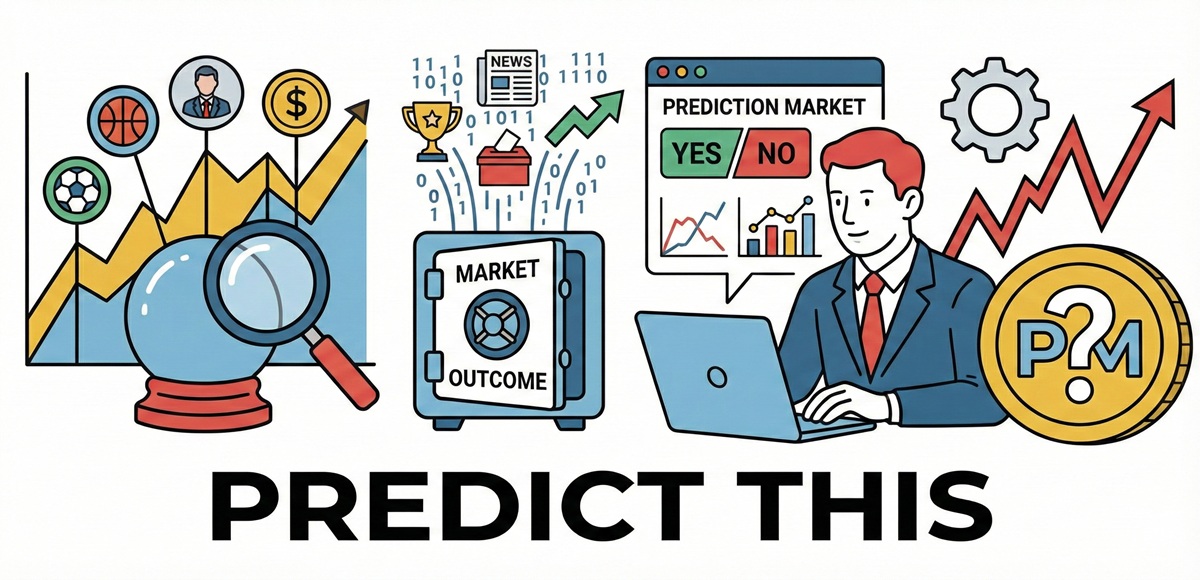
Wintermute has begun streaming two-sided quotes into prediction markets, adding institutional market-making infrastructure to venues including Polymarket and Kalshi. The London algorithmic trading firm, which handles more than $3.5 trillion in annual trading volume, said it is quoting continuous bid and offer prices across active event contracts as sector turnover moves past $20 billion per month. [The Block, Decrypt, The Defiant]
The delta from yesterday’s Kalshi/Coinbase perp approval is that prediction-market infrastructure is now attracting the same liquidity firms that scaled crypto derivatives. Wintermute is not entering as a directional bettor; it is entering as a spread-tightening intermediary designed to absorb larger trades and arbitrage fragmented order books.
For the industry, this is a maturation marker: prediction markets are moving from retail-driven catalyst betting toward venue competition over depth, latency, spreads, and professional liquidity. That benefits platforms with the most reliable APIs, clearest settlement rules, and enough volume to justify always-on quoting.
The Mechanism
- Wintermute gives prediction markets institutional plumbing. Continuous two-sided quoting should reduce slippage in high-volume contracts, especially around macro, politics, and crypto-native events where retail flow clusters and spreads can widen quickly.
- Kalshi gets a regulated-market-maker signal. Coming one day after Kalshi’s CFTC-cleared Bitcoin perp launch, Wintermute’s involvement reinforces Kalshi’s push to look less like a niche event-contract venue and more like a regulated derivatives exchange with multiple liquidity engines.
- Polymarket gets deeper offshore liquidity but more scrutiny. Wintermute’s participation improves execution quality on crypto-native prediction markets, but Polymarket is simultaneously facing sharper regulatory and market-integrity pressure after Indonesia’s block and the Google insider-trading case. [SCMP, Wired]
- Cross-venue pricing becomes more professional. A firm quoting both CFTC-regulated Kalshi and offshore Polymarket can mechanically compare prices across similar outcomes, though legal access, collateral, fees, and settlement rules still prevent a simple one-to-one arbitrage.
- Resolution quality becomes a market-maker requirement. Wintermute can price probability and flow, but event contracts add oracle and settlement risk. Venues with ambiguous rules, slow resolutions, or disputed outcomes will pay for that risk through wider spreads.
- Hyperliquid’s entry raises the infrastructure bar. Its move into native event markets puts prediction venues in direct competition with crypto exchanges that already optimize for speed, capital efficiency, and market-maker connectivity. [CoinDesk]
The Landscape
Market Position: Prediction-market volume is now large enough to pull in top-tier crypto liquidity firms rather than only retail traders, political sharps, and niche quant desks. Reports peg sector turnover above $20 billion per month and 2026 event-contract volume above $60 billion, with Polymarket and Kalshi remaining the core venues for Wintermute’s first push. Polymarket still dominates crypto-native event-market mindshare; Kalshi owns the cleanest U.S. regulated posture; Hyperliquid is testing whether its exchange-native user base can make event contracts a feature inside a broader derivatives venue rather than a standalone prediction-market product.
Regulatory Environment: The U.S. direction remains platform-friendly but compliance-heavy: the White House-backed CFTC primacy push and Kalshi’s perp approval both strengthen the federal derivatives framework for event markets. Outside the U.S., the opposite trend is visible: Indonesia blocked Polymarket as part of an online-gambling crackdown, showing that offshore liquidity can scale faster than local regulatory acceptance. The Google engineer case adds a separate market-integrity layer, pushing venues toward better surveillance, participant controls, and contract-design discipline.
Key Data
- Wintermute annual trading volume: more than $3.5 trillion across its broader algorithmic trading business. [The Block]
- Prediction-market monthly turnover: reported above $20 billion across leading venues as of early 2026. [The Defiant]
- 2026 event-contract volume: reported above $60 billion year-to-date. [The Defiant]
- Primary venues named: Wintermute is providing liquidity on major prediction platforms including Polymarket and Kalshi. [Decrypt]
- Market-integrity exposure: federal prosecutors alleged roughly $1.2 million in Polymarket profits tied to confidential Google Search information, a reminder that deeper liquidity will also attract more sophisticated abuse vectors. [CNN]
What's Next
The next catalyst is whether Wintermute’s quoting materially compresses spreads and increases large-ticket execution on Kalshi and Polymarket during the next high-volume macro or political contract cycle. If it does, expect more market makers to connect, more venues to publish institutional API and incentive programs, and more regulators to focus on surveillance rather than basic legality. The prediction-market race is shifting from “who can list the event?” to “who can host the deepest, cleanest, fastest market around it?”
Predict This covers the evolution of prediction markets — platforms, regulation, volume, and methodology. For questions or tips: reply to this email.
🌐 Visit whatsthelatest.ai for the latest coverage and more.
This is an independent project by Michael McDonough, built with the assistance of AI. Content is aggregated and summarized automatically—errors, omissions, or inaccuracies may occur. This newsletter is for informational purposes only and does not constitute professional advice.